What four construction law seminars in Sweden and Norway have taught us about change order management and the standards that govern construction and civil engineering projects.
This spring we took Endre on the road. Two events in Sweden with JUC's network for construction and property law, in Stockholm and Luleå. Two in Norway, Simonsen Vogt Wiig's "Bygg & Bagel", where more than 200 attended, and a morning seminar with SANDS where project owners, contractors, advisers, engineers and lawyers all sat at the same table. Different countries, different standards, different languages. One conversation kept repeating itself.
Change orders are still managed by email and Excel, or by closed systems. And the contract rarely forgives it.
The same problem in every market
This is not a local quirk. Arcadis, which advises on construction disputes worldwide, has named failure to properly administer the contract as its most common cause of disputes globally, year after year [1]. The work is rarely the problem. The paperwork around the work is.
After a Norwegian Supreme Court ruling in 2020, the law firm BAHR put the core issue plainly. On site, project managers "prefer common sense over formality" [2]. That is fair. Nobody becomes a project manager because they love notification deadlines.
But the contract does not reward common sense. It asks two questions. Did the notice come, and did it come in time.
That gap is what we heard in every room. In Luleå, the recurring theme was that contracts and standards are hard to follow in production. In Stockholm, that ÄTA is still handled manually despite being central to a project's economy and risk. In Oslo, that a notice without documentation does not hold, and documentation without a notice does not hold either. Different markets, same problem.
Four standards, one underlying logic
The Nordic countries each run on their own contract standard. The details differ. The logic does not.
Norway uses Norsk Standard. NS 8405 and NS 8407 are the heavy ones. A claim that is not notified "uten ugrunnet opphold," without undue delay, can be lost entirely. Lawyers call it preklusjon. The work was real, the money was earned, and the claim is gone because the paper was late. The bar is high: under NS 8405, the window to react is often counted in days, not weeks [4]. NS 8406 is softer, late notice there does not automatically extinguish the claim, which is why it suits projects where the owner needs less cost control [4]. Because Norway has the strictest notification requirements, it is also where missed notices create the most expensive disputes.
Sweden uses AB 04 and ABT 06, published by the Byggandets Kontraktskommitté [5]. The concept is ÄTA: ändrings-, tilläggs- och avgående arbeten. It is not a synonym for "change order." It is a defined legal idea, and it should be in writing. The catch is that Swedish law lets contracts form orally or by conduct [6], so what gets agreed on site and what can be proved later are often two different things. The conflicts tend to surface at slutreglering, the final settlement, when a contractor cannot prove what was verbally agreed months earlier. The standards are being modernised now under the AB 25 generation, which says something about how seriously the industry takes this [5].
Finland uses YSE 1998, the general conditions published by Rakennustieto and RAKLI [10]. The distinction that matters is "muutostyö" versus "lisätyö", change work versus additional work. Under §46, "lisätyöt" and their price must be agreed in writing before the work starts. No exceptions. This is where most Finnish disputes begin.
Denmark uses AB18. The principle is "den gode skriftlighed," good documentation practice. The pattern in Denmark is contractors starting "ekstraarbejde" before there is a signed "aftaleseddel", then struggling to get paid because of poor documentation.
Look past the vocabulary and the four standards say the same thing. Notify early. Agree in writing. Document as you go. The standards are not there to punish anyone. As we framed it at Bygg & Bagel: the change regime gives both parties a fair chance to react. The owner finds out while there is still time to choose. The contractor avoids carrying costs nobody was warned about.
Why documentation fails, in the experts' own words
We asked Andreas Falch Haugland, associate partner at Simonsen Vogt Wiig, what actually goes wrong. His answer was direct [7].
Oral clarifications are often impossible to document a year later, so claims can be lost in whole or in part. Unstructured email handling creates mess and a lot of extra work after the fact. And in the worst case the claim is lost outright if the emails cannot be found, which is typical when a person has left without their inbox being secured.
He made one point every contractor should tape to the wall. In disputes over compensation, the contractor "depends on documentation produced continuously during the project," not reconstructed afterwards [7]. Costs from forsering and plunder or “heft”, acceleration and disruption, are where contractors are weakest, because that evidence has to be captured in the moment or it is gone. Norwegian case law backs him up: in the HAB ruling, the Supreme Court set a high evidentiary bar for disruption claims, and the contractor lost [3].
Asked how many disputes could have been avoided with better documentation from day one, his answer was simple. He would not put a number on it, but that many could have been avoided is not in doubt. When documentation is so often the point of dispute, better documentation would have removed the dispute [7].
“The contractor depends on documentation produced continuously during the project.”
Andreas Falch Haugland, Associate Partner, Simonsen Vogt Wiig

What this means for the tool you use
This is the gap Endre is built to close. Not by turning the engineer into a lawyer. By giving the project a system that understands what the contract requires and says so before it is too late.
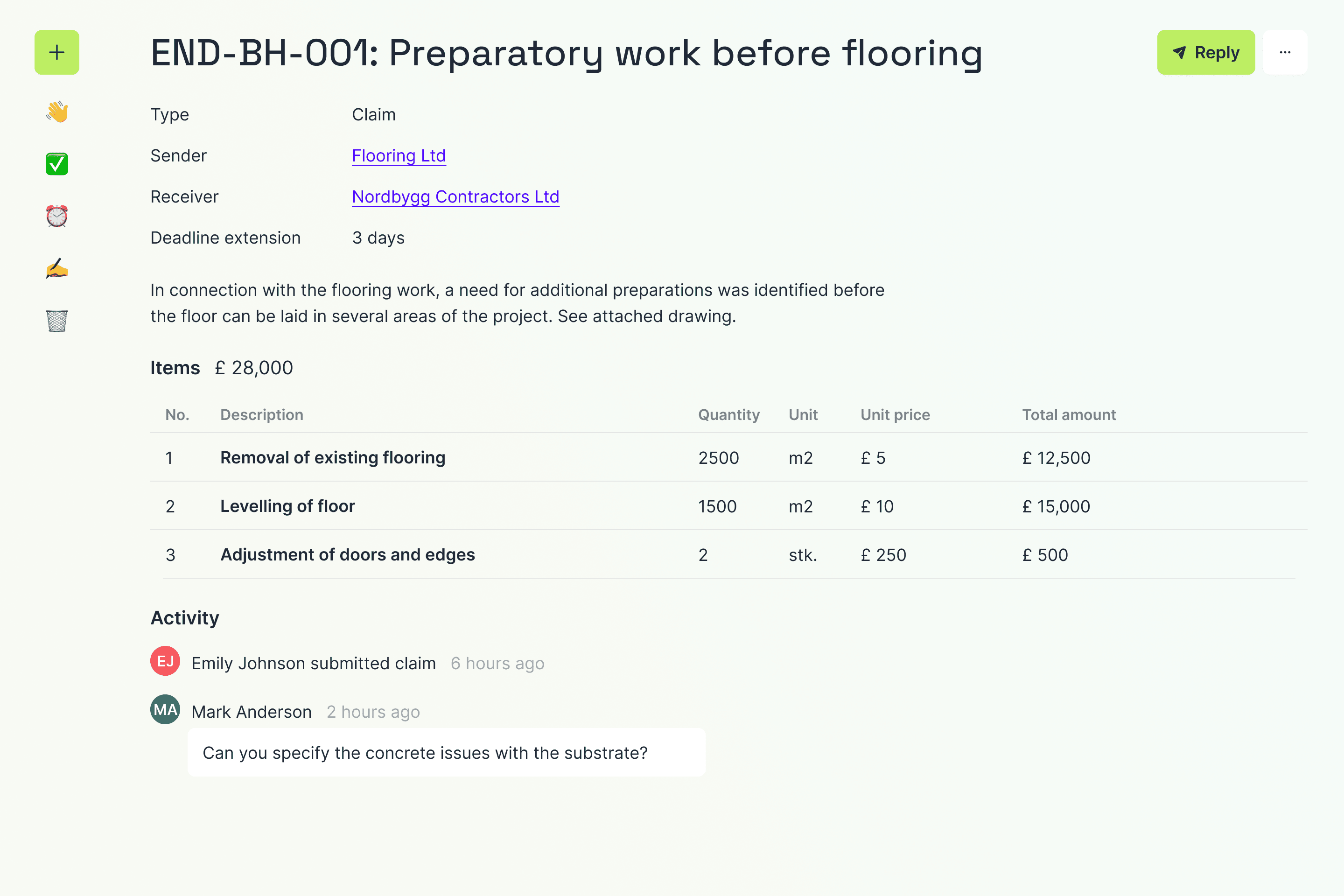
Endre is a shared system. Owner, contractor, adviser, lawyer and subcontractors all work in one place, with every notice, document, decision and the finances on a single timeline. Close to 200 projects across the Nordics run on it, with 40+ contractor and owner customers and 400+ subcontractors.
The next version goes further than collecting information in one place. It reads the standard contract in use, pulls out what matters for change handling, and guides the project to follow it. It reminds you that a rejected price offer means you should be invoicing the work weekly. It flags a notice still sitting without a claim for compensation attached.
The results are concrete. AF Energi cut administrative time on change handling by 80%. NRC Group saved more than 50 hours in two months on a single project. On Dronning Mauds Gate 15, AF Byggfornyelse managed more than 700 change orders without losing control. Across the industry, 10 to 15% of change revenue disappears without being invoiced. With Endre, that loss is reduced to near zero.
The legal value, proven on a live project
USBL, one of Norway's leading housing developers, sees the legal side most clearly. On the Fagerblom project they moved off Excel and folders and onto Endre [9]. Project manager Lars C. Hagen estimates they now spend less than half the time per change order, and that they "have better control of where cases stand at any given time" [9]. The bigger shift is certainty. Every change has a clear history, every decision a timestamp, every version traceable.
“We have better control of where cases stand at any given time.”
Lars C. Hagen, Project Manager, USBL

Their legal counsel, Amber Arthur, named the real mechanism. "Evidentiary uncertainty is a key driver of construction disputes," she said [9]. When documentation is built into the workflow, ambiguity drops and traceability strengthens. When the full history is searchable in one place, disagreements about what was said and decided get resolved faster and with far less friction.
“Evidentiary uncertainty is a key driver of construction disputes.”
Amber Arthur, Legal Counsel, Construction Contracts & Dispute Resolution, USBL

This is the benefit you do not see. When the record is already there, many disagreements never become disputes.
Where this goes next
AI can now draft a notice, shape a claim and suggest a response faster than any project manager working by hand. The question is no longer whether technology changes how we handle changes. It is how we use it without losing control.
After the SANDS seminar, partner Corinne Silden Stephensen summed it up in five words: "More collaboration. Less silo thinking" [8]. That is exactly what the industry needs, and it is what Endre is building toward.
“More collaboration. Less silo thinking.”
Corinne Silden Stephensen, Partner, SANDS

More collaboration. Less silo thinking. Every change, handled as agreed.
Sources
Arcadis, Global Construction Disputes Report (annual series). "Failure to properly administer the contract" is repeatedly identified as the most common global cause of construction disputes. https://www.arcadis.com/en-us/insights/perspectives/global/global-construction-disputes-report
Advokatfirmaet BAHR, newsletter on the Norwegian Supreme Court ruling of 20 November 2020 concerning notification "uten ugrunnet opphold" in standard contracts (Statens vegvesen v Rambøll). https://bahr.no/newsletter/entreprise-hoyesterettsdom-om-reklamasjon-uten-ugrunnet-opphold-samt-frist-for-a-fremme-reklamasjonsinnsigelser-i-prosjekteringskontrakter
The HAB ruling, Norwegian Supreme Court HR-2019-1225-A, on the evidentiary requirements for disruption (plunder og heft) claims.
Codex Advokat, on correct notification and preclusion under NS 8405 and NS 8406. https://codex.no/bedrift/entrepriserett/ns-kontrakter/korrekt-varsling-endring-ns-8405-8406
Chambers and Partners, Construction Law 2025: Sweden, on AB 04 / ABT 06, the Byggandets Kontraktskommitté (BKK), and the forthcoming AB 25 standards. https://practiceguides.chambers.com/practice-guides/construction-law-2025/sweden
Global Arbitration Review, Construction Arbitration: Sweden, on Sweden's reliance on standard agreements and case law, and on oral contract formation. https://globalarbitrationreview.com/insight/know-how/construction-arbitration/report/sweden
Andreas Falch Haugland, Associate Partner, Advokatfirmaet Simonsen Vogt Wiig. Written commentary provided to Endre in connection with the "Bygg & Bagel" seminar, June 2026.
Corinne Silden Stephensen, Partner and Head of Construction Oslo, SANDS Advokatfirma. Public reflection following the SANDS seminar on AI and change order management, 18 June 2026.
Endre, USBL / Fagerblom customer story, quoting Lars C. Hagen (Project Manager) and Amber Arthur (Legal Counsel, Construction Contracts & Dispute Resolution). https://about.endre.app/clients/usbl
Standards bodies referenced: Standard Norge (NS 8405 / NS 8406 / NS 8407), Byggandets Kontraktskommitté (AB 04 / ABT 06), Rakennustieto and RAKLI (YSE 1998), and the Danish AB-udvalget (AB18).